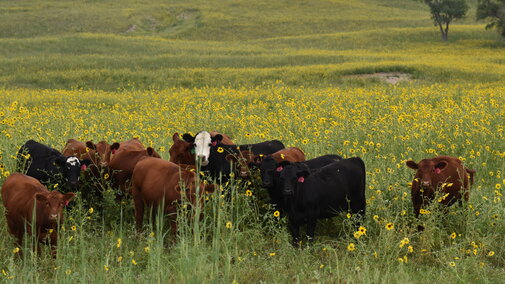
Our Research on Collaborative Adaptive Management at Barta Brothers Ranch
The Nebraska Sandhills region is one of the largest intact native grasslands remaining in the world. Sandhills grasslands are used primarily for beef cattle production, but these native environments also provide important wildlife and plant species habitat, wetlands and water infiltration for recharge of the Great Plains aquifer, and other ecosystem services such as recreation. Vegetation management typically includes a combination of grazing strategies, mechanical and chemical control of invasive plants and, less frequently, prescribed fire. Tradeoffs that occur among competing ecosystem services (e.g., soil health, cattle weight gain, economic return and wildlife diversity) and disservices (e.g., invasive species, low plant diversity and compromised soils) must be evaluated and quantified when making management decisions that have consequences for sustaining livelihoods.
In 2020, the University of Nebraska launched the Collaborative Adaptive Management (CAM) project to address risks and uncertainties related to grassland management in the Sandhills. This project focuses on evaluating stakeholder-driven management plans in a collaborative setting at Barta Brothers Ranch near Bassett, Nebraska. This emphasis on coproducing science ensures CAM reflects real-world ranching conditions of the Sandhills and the north-central Great Plains.
What is CAM?
The foundation of the CAM Project at Barta Brothers Ranch comes from its linkage to the adaptive management framework. Adaptive management is an iterative process to increase understanding of a system through a structured decision-making process. This includes:
- Defining the problem
- Identifying objectives
- Formulating evaluation criteria, estimating outcomes
- Evaluating trade-offs
- Deciding on actions to be taken
- Implementing action plan
- Monitoring system behavior
- Evaluating management outcomes
- Adjusting management
Results from the First Three Years of Burning
The first three years of the Collaborative Adaptive Management project at Barta Brothers Ranch focused on evaluating grassland management strategies in Nebraska’s Sandhills. The project used a burn-graze system, which led to increased livestock weight gain and improved bird diversity. Although burned areas showed more erosion, it remained within acceptable limits. There were no significant differences in total annual plant production between burned and unburned areas. These findings indicated that prescribed burning could be used alongside grazing without negatively impacting forage production or soil stability.

Fourth-Year Results
In 2025, Nebraska underwent drought and the governor banned burning. The CAM project remained adaptive and switched from the patch-burn grazing used in the first three years of the project to early-season focused grazing. Both grazing systems were compared with the standard four-pasture deferred rotation. In the early-season focused grazing, spayed yearling heifers were kept in one pasture from late May to mid-June 2025 and then released to all other pastures to graze. The 640-acre section used for the experiment was divided into four pastures separated by fences with gates, which were opened after the first pasture had been grazed. In the prior patch-burn grazing, researchers burned one pasture each spring and then gave the heifers access to the entire section. They had tracked cattle movements with GPS collars and found the cattle spent more time in the burned pasture, showing a preference for grazing its fresh regrowth.
In the first three years of the project, the heifers gained an average of 45 pounds more on the patch-burn pastures than the heifers in the deferred rotation did. At market, this equated to more than $100 per head. In the fourth year, when researchers pivoted to the early-season focused grazing, the heifers gained an average of 34 pounds more than the heifers in the standard deferred rotation. The researchers hypothesized the cattle might have still gained significant weight without fire because of the stock density, or how much area each animal was given, in the fourth year. In the focused grazing, the cattle had high stock density at first in the one pasture but low stock density later when the gates were open and they could graze all four pastures. Cattle easily found the gates and frequently returned to the pasture grazed early on.
Research from the first three years of the project also indicated that fire was an effective treatment for the spread of redcedars and that the Sandhills showed some resilience to burning and grazing in combination. The researchers found that of the 1,611 cedar trees in the pasture burned in 2024, fire killed about 72% of them. It killed about 80% of the trees less than a foot tall and about 20% of the trees over three feet tall. The pasture had only about 50 trees taller than three feet, and although fire did not kill them, it still proved useful because it made the taller trees more visible and land managers could spend less time taking out shorter trees.
Other findings from the first three years indicated that burning pastures in the Sandhills and then, soon after, allowing cattle to graze them did not seem to harm the soil, erode the land or change vegetation for long. With precipitation and the proper stocking rate, the land recovered within a year or two.
Keys to the Success of CAM at Barta Brothers Ranch
- Emphasize collaboration to address management uncertainties over time
- Focus on stakeholder knowledge, experience and leadership
- Engage stakeholders represented across the region: Sandhills ranchers, Nebraska Game and Parks Commission, Nebraska Forest Service, Natural Resources Conservation Service, U.S. Fish and Wildlife Service, The Nature Conservancy and the Sandhills Task Force
- Support from USDA North Central SARE, the Nebraska Environmental Trust and the University of Nebraska
About Barta Brothers Ranch
The Barta Brothers Ranch is a 6,000-acre property donated to the university by Clifford and James Barta in 1996. It is used by scientists, extension educators and students to compare livestock grazing systems, study complex plant communities and explore water interactions in grasslands. The ranch serves as a model ranch, providing the facilities and support needed to conduct research and demonstrations relevant to Sandhills ranchers. Educational programs from the ranch play an important role in training students and continuing education for ranchers, conservationists and representatives of federal and state agencies.